
Tax Tips: Understanding Tax Brackets
Many people find understanding tax brackets difficult, so we're here to demystify them for you.


When I have conversations with people about their taxes, I often want to get a sense of how familiar they are with the system in order to get a sense of how best to discuss what needs to be discussed, or explain what needs to be explained.
An easy litmus test is to ask something like the following: If earning an extra $1000 would put you into the next higher tax bracket, would you want it?
I so often hear "No!" But the correct answer is "Yes, absolutely!"
Those answering 'no' are who this post is for. That answer is based on not quite fully understanding how tax brackets and marginal tax rates work. So let's fix that right now! What I have to say applies to other countries, but I'll be sticking to Canada for my examples.
Here are the tax brackets for 2023 (the tax brackets for the returns you should have me working on soon!).
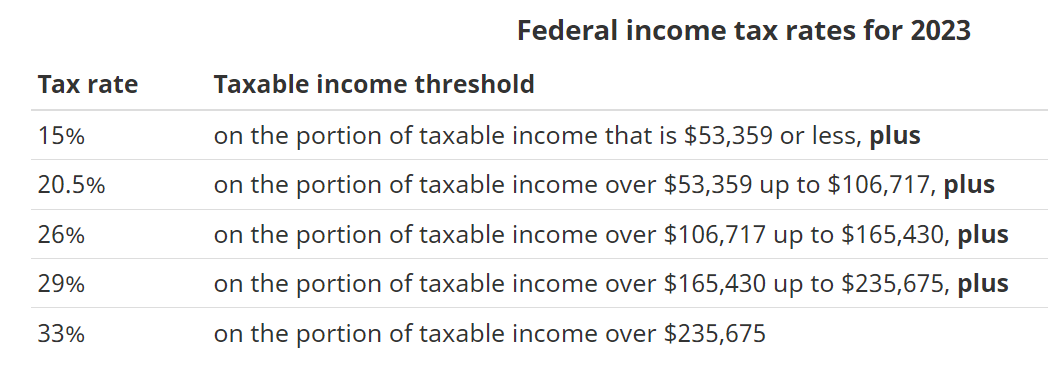
If you earn up to $53,359 of net taxable income, then you'll pay 15% of what you earned. There are a tonne of caveats because the tax rate is only applied to taxable income, which is after any tax deductions and tax credits (a topic for a future post!). So your effective tax rate will always be lower than 15%.
Now suppose you earned $53,000 in 2023. And I ask you that question from earlier: "If I offered you an extra $1000 of taxable income, which would put you over the $53,359 limit for the 15% tax bracket, and put you into the 20.5% tax bracket, would you want it?"
You should say "yes" because the next higher tax bracket (20.5%) only applies to any taxable income you earn over and above $53,359, and up to $106,717).
So that extra $1000 would put your taxable income at $54,000. Assuming no deductions or credits (and there are always deductions and credits), you would pay 15% on $53,359 and 20.5% on $54,000 - 53,359 = $641.
Earning more money such that it puts your overall taxable income in a higher tax bracket does not mean the higher tax bracket is applied to all of your income. Tax brackets work on the marginal tax rate system.
Think of it like a series of hollow steps. You start by filling the lowest bucket until it hits $53,359. You pay 15% tax on that. Your next dollar goes into the 20.5% bucket, and any income between $53,359 and $106,717 will be taxed at 20.5%.
And it keeps going. If you earn anything over $106,717 (up to 165,430), that goes into filling up the next bucket, and will be taxed at 26%.
So let's say you earn $150,000 of taxable income (after deductions and credits). Here's what you'll pay in federal tax for the year 2023:
15% on the first $53,359 = $8,003.85
20.5% on the next $53,358 = $10,938.39
26% on the final $43,283 = 11,253.58
For a total tax burden of $30,195.82. Since you earned $150,000 in taxable income, your effective tax rate is 20.13%.
So to answer the original question: yes, you want to make more money even if it puts you in a higher tax bracket. The extra money does not cause the original amount to be taxed at a higher rate.
Now you understand how tax brackets work!